Authentic Napa Cabbage Kimchi Recipe (Baechu Kimchi)
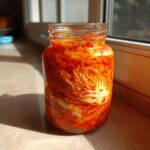
Learn how to make traditional, crispy Napa Cabbage Kimchi at home using this easy guide. Master the brining process and the flavorful gochugaru seasoning paste for authentic Korean flavor.
- Prep Time: 2 hours 30 min
- Cook Time: 10 min
- Total Time: 2 hours 40 min (plus 1-7 days fermentation)
- Yield: About 6 servings 1x
- Category: Side Dish
- Method: Fermenting
- Cuisine: Korean
- Diet: Halal
Ingredients
Scale
- 3 lbs Napa cabbage
- 1 cup coarse sea salt or kosher salt (for brining)
- 1/2 cup sweet rice flour (or regular all-purpose flour)
- 1 cup water
- 1/4 cup sugar
- 1/2 cup Korean fish sauce (Myeolchi Aekjeot)
- 1/4 cup salted fermented shrimp (Saeujeot), minced
- 1/2 cup Gochugaru (Korean chili flakes)
- 1/4 cup garlic, minced
- 1 tablespoon fresh ginger, grated
- 1 small Asian pear or apple, grated (optional, for sweetness)
- 1/2 cup Korean radish (mu), julienned
- 1 cup scallions, cut into 1-inch pieces
Instructions
- Cut the Napa cabbage lengthwise into quarters, keeping the core intact to hold the leaves together. If the heads are very large, you can cut them in half again.
- Prepare the brine: In a large bowl, dissolve 1/2 cup of the salt in 8 cups of water. Submerge the cabbage quarters completely. Let them soak for 1.5 to 2 hours, turning them every 30 minutes. The leaves should become pliable and bend without snapping.
- Rinse the brined cabbage thoroughly under cold running water three times to remove excess salt. Drain the cabbage well in a colander for at least 30 minutes, allowing excess water to drip off. Squeeze each quarter gently to remove more water.
- Make the porridge base: In a small saucepan, whisk the sweet rice flour and water together until smooth. Heat over medium heat, stirring constantly until the mixture thickens into a paste (about 5-7 minutes). Remove from heat and stir in the sugar until dissolved. Let this cool completely.
- Prepare the seasoning paste (Yangnyeom): In a large bowl, combine the cooled porridge, fish sauce, minced saeujeot, Gochugaru, minced garlic, grated ginger, and grated pear (if using). Mix well until you have a thick, deep red paste.
- Fold in the vegetables: Add the julienned Korean radish and scallions to the seasoning paste. Mix gently to coat.
- Spread the paste: Wearing gloves, take one cabbage quarter at a time. Spread a thin, even layer of the seasoning paste between every leaf, starting from the outer leaves and working toward the core. Do not over-pack the paste.
- Pack the kimchi: Fold the outer leaves around the quarter to form a neat bundle. Place the kimchi tightly into an airtight fermentation container or large glass jar, pressing down firmly to eliminate air pockets. Leave at least 1-2 inches of headspace at the top.
- Ferment: Leave the container at room temperature (around 68-72°F) for 1 to 2 days, depending on the ambient temperature. Check daily for bubbling. Once it starts bubbling slightly, transfer it to the refrigerator.
- Store and age: Refrigerate for at least one week before eating for the best flavor development. Your homemade kimchi will continue to ferment slowly in the fridge for several months.
Notes
- For crispy kimchi, do not over-brine the cabbage. The goal is to wilt the leaves, not fully pickle them during the initial soak.
- If you cannot find saeujeot (salted shrimp), you can increase the fish sauce slightly, though the authentic flavor will be slightly altered.
- For a vegan kimchi alternative, omit the fish sauce and saeujeot, and substitute with 1/4 cup of soy sauce and 1 tablespoon of kelp broth powder mixed into the paste.
- Always use gloves when handling the Gochugaru paste to prevent skin irritation.
Nutrition
- Serving Size: 1 cup
- Calories: 55
- Sugar: 4
- Sodium: 650
- Fat: 0.5
- Saturated Fat: 0.1
- Unsaturated Fat: 0.4
- Trans Fat: 0
- Carbohydrates: 11
- Fiber: 2
- Protein: 2
- Cholesterol: 5
Find it online: https://cookingzenith.com/napa-cabbage-kimchi-recipe-easy-guide/